


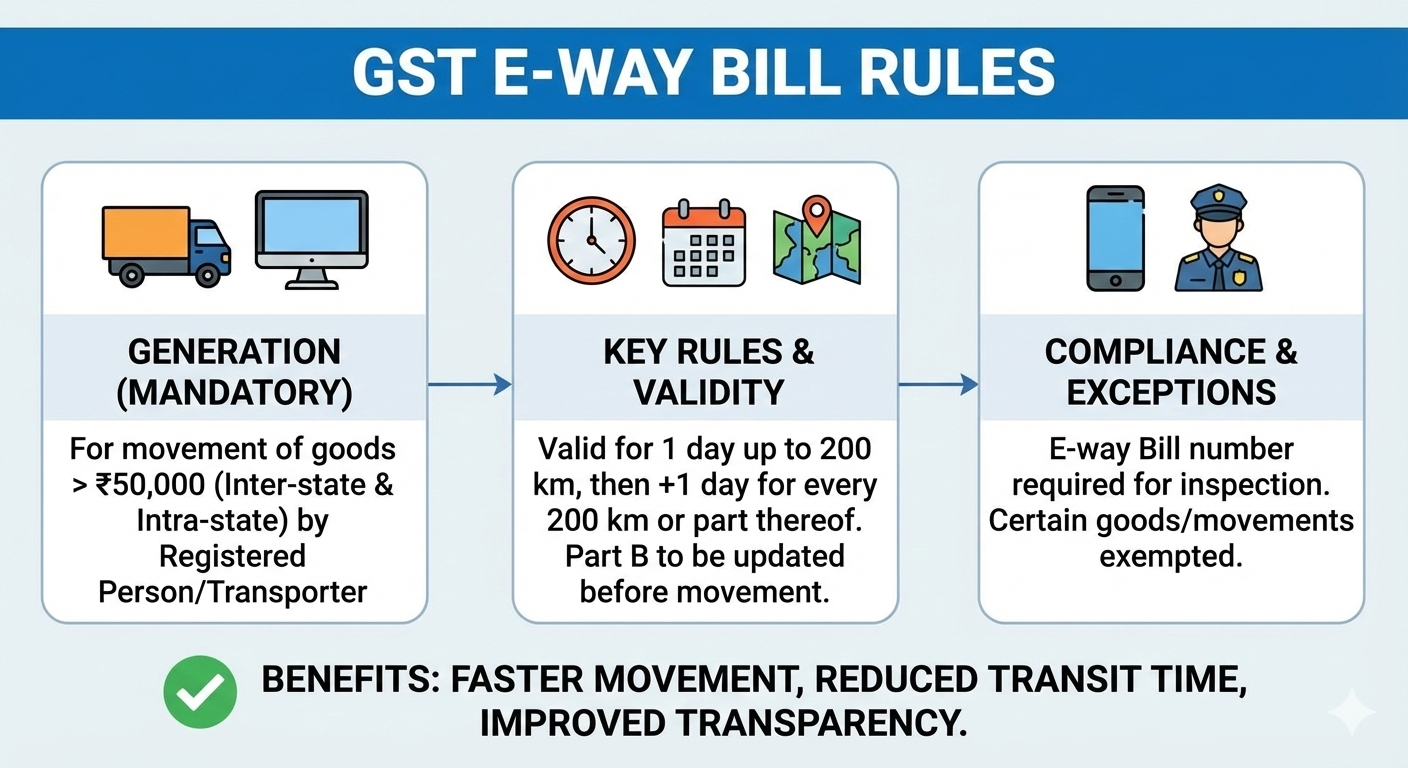

Starting January 1, 2025, the Goods and Services Tax (GST) Council has introduced a significant change related to the E-Way Bill system in India. The new rule aims to enhance compliance, reduce fraudulent transactions, and streamline the logistics and transportation of goods across states.
The update focuses on the validity period of document details used for generating an E-Way Bill — a critical document for the movement of goods worth more than ₹50,000 under GST regulations.
What is an E-Way Bill under GST?
An E-Way Bill (Electronic Waybill) is a digital document required for the transportation of goods under the GST Act. It contains key details such as the consignor, consignee, goods description, quantity, and value.
The E-Way Bill ensures transparency in supply chain management and prevents tax evasion by tracking the movement of goods in real-time through the GST E-Way Bill portal
New GST E-Way Bill Rule: Effective 1 January 2025
According to the latest GST notification, effective from January 1, 2025, taxpayers can generate an E-Way Bill for document details (such as invoices, challans, or delivery notes) up to 180 days from the date of generation of the document.
Earlier Scenario:
Previously, there was no fixed limit on how long after generating a document an E-Way Bill could be created. This sometimes led to delays, discrepancies, and potential misuse of invoice dates.
New Rule Implementation:
With the new update, if a document (like an invoice or challan) is older than 180 days, taxpayers will not be able to generate an E-Way Bill using that document.
This means that E-Way Bill generation must occur within 180 days from the document’s creation date.
Objective of the New Rule
The Government’s move aims to:
Enhance GST compliance by ensuring timely transportation and invoicing.
Reduce misuse of old or backdated invoices.
Improve accuracy in the movement and reporting of goods.
Streamline logistics and prevent discrepancies during audits.
Key Points of the New E-Way Bill Rule (2025)
| Aspect | Details |
|---|---|
| Effective Date | 1st January 2025 |
| Applicable Law | Rule under GST E-Way Bill provisions |
| Main Change | E-Way Bill can be generated only for documents created within 180 days |
| Document Types Covered | Invoices, Delivery Challans, Credit/Debit Notes, etc. |
| System Restriction | Portal will automatically restrict E-Way Bill generation after 180 days |
| Impact | Ensures timely reporting and movement of goods |
Impact on Businesses
The 180-day limit for E-Way Bill generation will affect multiple stakeholders in the supply chain:
1. Manufacturers and Suppliers
They need to ensure that invoices and challans are updated in the system promptly to avoid rejection by the E-Way Bill portal.
2. Transporters
Transport agencies must coordinate with suppliers to confirm that valid E-Way Bills are generated within the allowable timeframe.
3. Accountants and GST Practitioners
Accounting teams should revise internal compliance systems to monitor the age of documents before attempting to generate an E-Way Bill.
Compliance Tips for Businesses
To stay compliant with the new E-Way Bill rule:
Review and update document generation practices.
Implement automated alerts for invoices nearing the 180-day limit.
Regularly reconcile GST data to ensure timely E-Way Bill creation.
Train staff on the new rule to avoid penalties or shipment delays.
Penalties for Non-Compliance
If an E-Way Bill is not generated or is generated using an invalid document (older than 180 days):
Goods may be detained or seized during transportation.
Businesses may face monetary penalties under Section 129 of the CGST Act.
It may also impact the Input Tax Credit (ITC) reconciliation process.
The new E-Way Bill rule under GST, effective from January 1, 2025, mandates that taxpayers can only generate E-Way Bills for documents created within 180 days.
This initiative strengthens GST compliance, improves data accuracy, and ensures the timely movement of goods. Businesses should update their billing systems and internal compliance processes to align with this change and avoid future penalties.
Why Learn a GST Course?
Understanding Goods and Services Tax (GST) is essential for anyone involved in business, accounting, or finance. With GST being a unified tax system across India, learning it not only builds your professional value but also opens doors to multiple career opportunities.
Benefits of Learning GST and Taxation
1. Career Opportunities
By completing a GST Certification Course, you can work as a GST Practitioner, Tax Consultant, Accountant, or Finance Executive. The demand for GST-trained professionals is growing across industries.
2. In-Depth Tax Knowledge
You’ll gain a clear understanding of GST registration, return filing, e-Way Bill generation, and input tax credit, helping you handle taxation tasks confidently and accurately.
3. Business and Compliance Advantages
For entrepreneurs and business owners, GST knowledge ensures proper invoice management, tax compliance, and error-free filing, reducing penalties and financial risks.
4. Freelance & Consultancy Opportunities
Become a Certified GST Practitioner and start offering freelance GST filing and advisory services to clients and small businesses.
5. Stay Industry-Relevant
With constant updates in GST rules and technology, having formal training helps you stay updated, compliant, and competitive in the job market.
Join the Best GST Course in Coimbatore
Our GST course is designed for both beginners and professionals. Through practical sessions, real-time case studies, and expert mentorship, you’ll master GST filing, E-Way Bill generation, and taxation compliance.
Start your journey today and become a Certified GST Practitioner—your gateway to a successful career in finance and taxation!